H Pattern Flooring: What It Is, Why It Happens, and How to Fix It

What Is an H Pattern in Flooring?
An H-pattern in flooring happens when end joints line up across multiple rows, creating a repeating “H” shape.
This usually occurs when planks are installed without proper staggering, making the pattern obvious and unnatural.
In most cases, it’s considered a poor installation practice — especially with vinyl plank and laminate flooring.
Why Does H Pattern Flooring Happen?
H-pattern flooring usually happens when installers:
- Use full-length boards repeatedly
- Don’t stagger end joints properly
- Try to speed up installation
- Don’t follow manufacturer guidelines
Most flooring manufacturers require random staggering to avoid this issue.
Many homeowners only notice an H-pattern after installation is complete — which leads to the biggest question:
How to Fix H Pattern Flooring
Fixing an H-pattern depends on how widespread the issue is and the type of flooring installed.
Small Areas (Best Case)
If the pattern only affects a few rows, you can sometimes unlock the planks and restagger them correctly.
This works best with floating floors like vinyl plank or laminate where the locking system is still intact.
Moderate Issues
If the pattern repeats across multiple sections, you may need to remove and reinstall part of the floor.
In most cases, this means:
- Removing several rows
- Cutting new starter pieces
- Reinstalling with proper stagger spacing
Entire Floor (Worst Case)
If the H-pattern runs across the entire room, the only true fix is full reinstallation.
At this point, trying to “patch” the pattern usually won’t work.
⚠️ Important:
Before reinstalling, make sure your subfloor is flat and properly prepped — or the problem will come back.
Most manufacturers require:
- 3/16″ over 10 feet
🔧 Installer Tip:
If the floor isn’t flat, planks won’t sit correctly and joints will line up or separate over time.
👉 Check your floor with a long straight edge or level before reinstalling:
[Check recommended leveling tools]
Why Professional Installers Avoid H-Pattern Flooring
Most professional installers avoid H-pattern layouts because they create visible repetition, highlight plank seams, and make flooring look artificial. Even when the floor is installed correctly, repeating joint lines draw the eye and exaggerate minor subfloor imperfections. Over time, these patterns can make a floor feel busy and unfinished compared to properly staggered layouts.
If you’ve ever walked into a room and immediately noticed repeating lines running across the floor, you’ve probably seen an H-pattern installation. This happens when flooring end joints line up in consistent rows instead of being randomly staggered. If you’re still deciding which flooring material fits your lifestyle, traffic levels, and durability needs, this comparison of carpet vs LVP for real homes breaks down the real-world pros and cons beyond marketing claims.
While some installers allow this layout, most professionals avoid it — and for good reason. H-patterns can make a floor look artificial, highlight seams, weaken visual flow, and even increase the chance of long-term movement issues.
If your vinyl plank seams line up every other row, you likely have an H-pattern installation.
In this guide, we’ll explain what an H-pattern is, why it’s usually a mistake, and how to achieve a cleaner, more professional layout.
Many H-pattern and joint failures are actually caused by uneven subfloors.Uneven floors are one of the biggest reasons floating floors fail. If you’re unsure whether your floor meets manufacturer standards, read How Flat a Subfloor Needs to Be for Vinyl Plank Flooring.
Before installing any floating floor, it’s critical to check and flatten the surface properly.
We’ve put together a complete installer guide to the best floor leveling tools here.
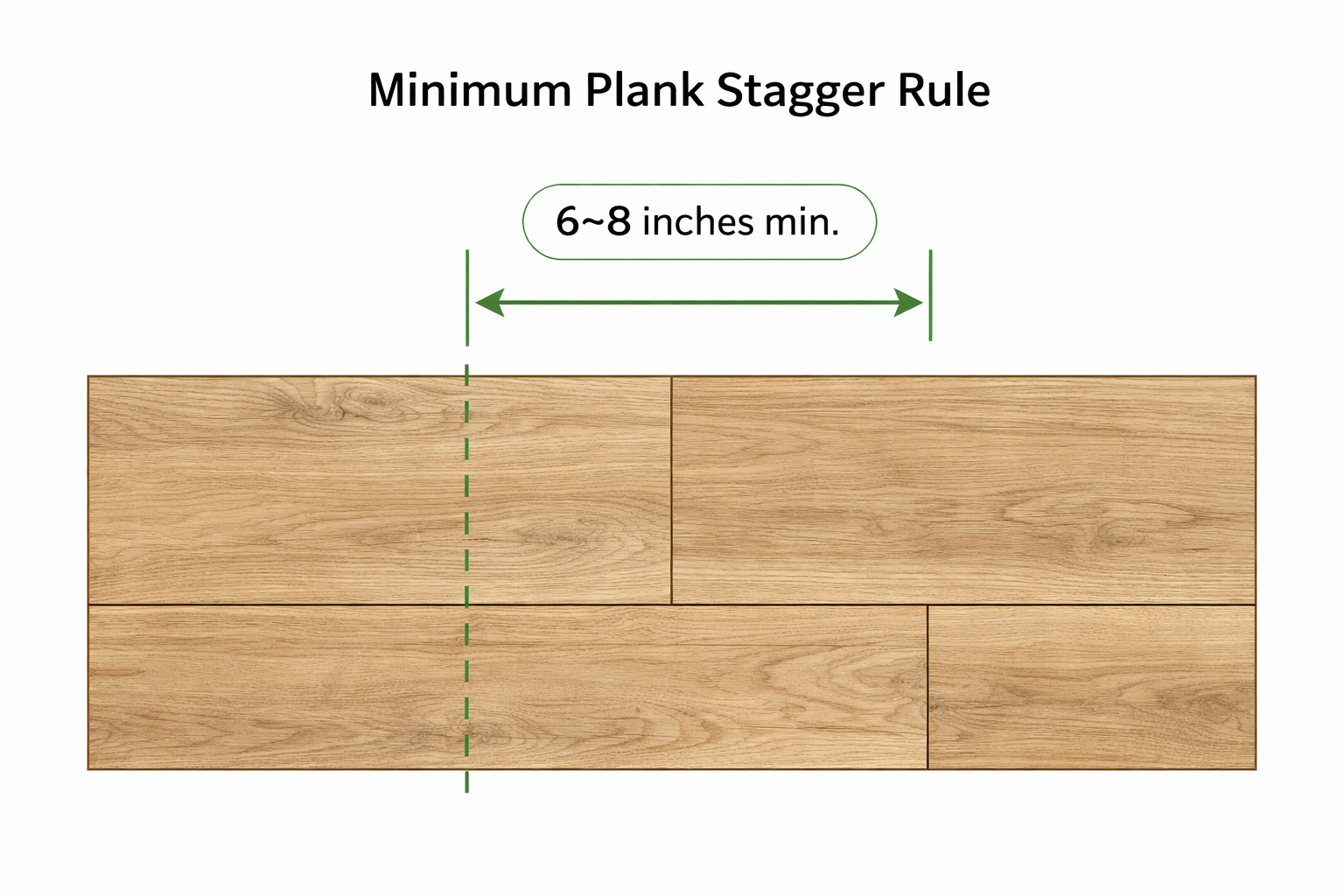
Minimum Stagger Spacing for Vinyl Plank Flooring
Can You Fix H-Pattern Flooring Without Reinstalling the Floor?
Many homeowners don’t realize their floor has an H-pattern until the installation is finished and the repeating seams become obvious.
Unfortunately, once a floating floor is fully installed, fixing an H-pattern is not always simple. However, there are a few possible solutions depending on how widespread the pattern is.
Replace Small Sections
If the H-pattern only appears in a few rows, installers can sometimes unlock several rows of flooring and reinstall those planks with proper staggering.
This works best with floating vinyl plank or laminate flooring where boards can still be separated without damaging the locking system.
Break the Pattern With Shorter Boards
Another option is removing a few planks and reinstalling them using shorter cut pieces. This breaks the repeating seam pattern and makes the floor look more natural.
Full Reinstallation
If the pattern repeats across the entire room, the only true fix is reinstalling the flooring with proper staggering between rows.
Most flooring manufacturers recommend staggering plank end joints at least 6–8 inches to prevent repeating patterns.
What Is an H-Pattern in Flooring?
An H-pattern occurs when the short end joints of planks line up every few rows, creating a visible repeating pattern across the floor.
This most commonly happens with:
- Luxury Vinyl Plank (LVP)
- Laminate flooring
- Engineered hardwood
The pattern forms when installers:
- Reuse the same plank cut length repeatedly
- Don’t vary starting plank lengths
- Focus on speed instead of layout planning
At first, it may not stand out. But once light hits the floor or furniture is placed, the repeating seams become very noticeable.
Many homeowners searching for vinyl plank stagger pattern problems are actually dealing with an H-pattern layout where plank joints repeat too evenly instead of being properly offset.
If your vinyl plank seams are separating or unlocking, read our guide on why vinyl plank seams separate.
Minimum Stagger Requirements for Vinyl Plank Flooring
Most vinyl plank manufacturers require a minimum stagger of 6–12 inches between plank end joints.
This spacing helps distribute movement across the floor and prevents weak points where seams line up too closely.
When planks are installed with little variation or in repeating rows, stress concentrates along those seams. Over time, this can lead to:
- Joint separation
- Unlocking planks
- Visible pattern lines across the floor
Always follow the manufacturer’s installation guidelines for your specific flooring product.
Why H-Patterns Should Be Avoided
- It Looks Artificial
Natural wood flooring never repeats perfectly. H-patterns create a grid-like appearance that looks manufactured and unnatural. - Seams Become More Visible
Aligned joints draw attention to the seams instead of the plank texture or grain. - Increased Risk of Movement Issues
When joints line up repeatedly, movement is concentrated in the same areas. This increases the chance of gaps or separation over time. - Hurts Perceived Quality
Even brand-new floors can look poorly installed when patterns repeat. Many buyers and inspectors recognize this immediately.
H-Pattern vs Staggered Flooring Layout

For most residential installations, a randomized stagger pattern is the preferred approach.
Staggered flooring layouts are designed to look natural and distribute stress evenly across the floor.
Compared to H-pattern layouts:
- Visual appearance: Staggered patterns look random and realistic
- Joint strength: Movement is spread out instead of concentrated
- Manufacturer guidance: Most flooring brands recommend staggered seams
- Long-term performance: Less risk of visible wear patterns or separation
Because of these factors, staggered layouts are generally preferred for both residential and commercial installations.
H-Pattern Flooring: Pros and ConsPros:
- Faster installation in some cases
- Less material waste when plank lengths are limited
- Can meet minimum spacing requirements if done correctly
Cons:
- Creates visible repeating patterns
- Makes seams stand out
- Can concentrate stress on joints
- Considered poor practice by most professional installers
- May affect warranty if spacing requirements are not followed
What To Do Instead: Use a Randomized Staggered Layout
What Is the Correct Stagger Pattern for Vinyl Plank Flooring?
Most vinyl plank manufacturers recommend staggering end joints by at least 6–12 inches between rows.
A proper stagger pattern should appear random, not repetitive. When seams line up every row or every few rows, it creates a visible pattern that draws attention to the joints.
Best practices include:
- Maintain at least 6–12 inches between end joints
- Avoid repeating the same starting plank length
- Mix full planks with cut pieces
- Dry-lay several rows before locking them in
- Step back and visually check the layout during installation
When installed correctly, a staggered layout creates a more natural look and reduces stress on locking joints over time.
If your planks are separating or unlocking, read our guide on why vinyl plank seams separate.
This creates a more natural flow and hides seams visually.
If you’re choosing new flooring thickness or material, this guide breaks down what actually matters long-term:Is 6mm WPC LVP Thick Enough? What Homeowners (and Installers) Get Right and Wrong.
Why DIY Installers Accidentally Create H-Patterns
Most H-pattern floors are not intentional.
They usually happen when installers start each row using the leftover cut piece from the previous row. While this reduces waste, it often creates repeating seam patterns every few rows.
Professional installers avoid this by:
- Planning multiple starting plank lengths
- Mixing cuts intentionally
- Checking layout before locking rows together
Saving a few pieces of material isn’t worth creating a visible pattern across the entire floor.
CAN YOU FIX H-PATTERN FLOORING
Fixing an H-pattern depends on how widespread the pattern is and the type of flooring installed.
Replace Small Sections
If the pattern appears in only a few rows, it may be possible to unlock and reinstall those sections with proper staggering. This works best with floating floors that can be separated without damaging the locking system.
Break the Pattern
In some cases, removing a few planks and reinstalling them with shorter cut pieces can disrupt the repeating pattern and make it less noticeable.
Full Reinstallation
If the pattern repeats throughout the entire room, the only true fix is reinstalling the floor with proper staggering.
If the floor is glued or nailed, repairs are usually not practical without replacement.
If the pattern truly bothers you or affects value, correcting it early is cheaper than living with it long term.
Can H-pattern flooring cause floors to fail?
Yes — in some cases.
While H-pattern flooring is often considered a visual issue, repeating joints can create weak points in floating floors. When movement concentrates along the same seam lines, planks are more likely to separate, unlock, or develop gaps over time.
This is especially common when:
- The subfloor is not flat
- Moisture is present
- Stagger spacing is too small
This is why most manufacturers recommend a random stagger pattern instead of repeating layouts.
When an H-Pattern Might Be Acceptable
- Certain glue-down commercial flooring
- Small rooms with limited plank variation
- Designs approved by the manufacturer’s installation guide
Always check the manufacturer’s installation instructions before choosing a layout, as improper patterns can affect warranties.
Before installing any LVP, laminate, or engineered floor, make sure your subfloor meets manufacturer flatness standards.
How flat a subfloor needs to be
Using the right straightedges, levels, and patching tools can prevent gaps, hollow spots, and warranty issues.
See our full guide to the best floor leveling tools.
Pro Tip
Always review plank layout before installation begins. A few minutes of planning can prevent years of regret.
If you’re hiring an installer, clearly communicate that you want a randomized stagger pattern — not an H-pattern layout.
After decades working in flooring installation, H-pattern layouts are one of the most common layout mistakes I see in new floors.
Many installers focus on speed instead of layout planning. But taking a few minutes to vary plank cuts and stagger joints properly can dramatically improve the finished floor.
A good installer plans the layout before the first row is installed.
Many DIY installers accidentally create H-patterns because they start each row using the leftover cut piece from the previous plank. While this seems efficient, it often produces repeating seam patterns every few rows.To avoid this problem:
• Start each row with a different plank length
• Keep seams at least 6–12 inches apart
• Dry-lay several rows before locking planks
• Step back occasionally and visually check the layout
A few minutes of planning can prevent visible seam repetition and create a more natural floor pattern.
How to Tell If Your Vinyl Plank Floor Was Installed Incorrectly
Many homeowners start researching H-pattern flooring after noticing seams lining up across the room. But repeating seams are only one sign that a vinyl plank floor may have been installed incorrectly.
Here are a few warning signs to look for:
1. Seams Line Up Every Other Row
If plank joints repeat in straight lines across the floor, it usually means the installer used the same starting plank length repeatedly. This creates the H-pattern effect and makes seams more noticeable.
2. End Joints Are Too Close Together
Most vinyl plank manufacturers require 6–12 inches of stagger between seams. If joints are closer than this, the floor may develop weak points where movement concentrates.
3. The Floor Feels Soft or Bouncy
A floating floor should feel solid underfoot. If planks flex when you walk across them, the subfloor may not have been properly flattened before installation.
4. Seams Are Separating
When joints repeatedly line up in the same areas, stress concentrates along those seams. Over time this can cause boards to unlock or develop gaps.
If you are seeing multiple issues like these, the problem is often related to floor preparation rather than the flooring itself. Uneven subfloors are one of the biggest reasons floating floors fail. Before installing flooring, it’s important to understand how flat a subfloor needs to be for vinyl plank flooring.Before installing any floating floor, it’s critical to check that the surface meets manufacturer flatness requirements.
See our guide on How Flat a Subfloor Needs to Be for Vinyl Plank Flooring.
FAQ: Is H-Pattern Flooring Installed Wrong?
H-pattern flooring is not always considered a structural installation failure, but most flooring manufacturers and professional installers recommend avoiding it.
The H-pattern occurs when plank end joints line up in repeating rows instead of being staggered randomly across the floor.
While the floor may still lock together and function normally, this layout can cause several issues:
- seams become visually obvious across the floor
- repeating lines make the floor look artificial
- plank joints may concentrate stress in the same areas over time
For these reasons, most flooring manufacturers recommend staggering plank joints by at least 6–8 inches between rows to create a more natural appearance and better distribute movement across the floor.
In most homes, H-pattern flooring is mainly an appearance issue rather than a structural failure, but installers usually avoid it because the pattern becomes very noticeable once furniture and lighting highlight the repeating seams.
WARNING SIGNS
If you’re unsure whether your floor was installed correctly, here are common warning signs:
- Seams line up across the room
- End joints are too close together
- The floor feels soft or bouncy
- Seams are separating or unlocking
In many cases, these issues are tied to poor subfloor preparation rather than the flooring itself.
Before installing any floating floor, always check that the subfloor meets manufacturer flatness requirements.
What Are H Joints in Flooring?
H joints are another term used to describe the same issue — where end joints line up in a repeating pattern instead of being staggered.
This is commonly seen in poorly installed laminate and vinyl plank floors.
PRO TIP
Always plan your plank layout before installation begins.
A few minutes of layout planning can prevent years of frustration. Once a repeating pattern is installed across a room, it becomes very difficult to correct without major rework.
If you’re hiring an installer, make it clear that you want a randomized stagger pattern — not a repeating layout.
Final Thoughts
H-pattern flooring may meet minimum installation requirements, but it rarely delivers the professional look most homeowners expect.
A properly staggered layout improves appearance, reduces stress on joints, and helps the floor perform better long term.
Most flooring failures aren’t caused by the product — they’re caused by poor preparation and installation choices.
Understanding layout patterns before installation can save you time, money, and frustration.
Leave a Reply